Categories
Punk/Rock Reviews

Brian Destiny: “You’ve Got to Be Doing Something with Love.”

Brian Destiny and Nathan Saoudi are the same person. Most of the time. 

Nathan, with his mop of dark curls and film star grin, is perhaps the most constant member of south London rock n’ rollers the Fat White Family, helping to write the band’s material, as well as playing keyboard and providing backing vocals. In his elder brother Lias’s words, he’s the “anchor” of the band, the emotional bomb diffuser, the only stable element in a roomful of exceedingly reactive molecules. 

Nathan is the Fat White Family. He’s the eerie, funhouse cascade of keyboard that kicks off “Bomb Disneyland.” The bouncing, delirious chords of “Touch the Leather.” The addictive melody of “Feet,” (inspired by the siren call of Algerian rai and good, old-fashioned disco, with three million streams on Spotify and counting.) No Fat White Family gig is complete without Nathan going manic at the end, dragging his keyboard over and playing it on his knees, occasionally using his skull, his nose, or his teeth to coax unearthly sounds from the machine, sonically lacing together Lias’s frenzied screams and Alex White’s Maceo-Parker-on-acid sax, into something beautiful yet apocalyptic. 

The Fat White Family are often derided for their punkish behavior (boozing, drugging, and participating in constant public tiffs with other bands) but musically, they’ve produced some of the most exciting, innovative sounds of the past decade. It’s a case of the public not being able to see the forest for the trees. C’mon, guys: Beethoven is here. Liszt is in the building. Open your eyes. Open your ears. 

The band has spent the last ten years in a relentless cycle of writing, recording, and touring. The pandemic stopped it all, but Nathan’s not one to bemoan what can’t be helped. He’s kept busy working on his newest solo venture, a band called Brian Destiny, along with the launch of his own record label, Dash the Henge. 

And so, on the day before Halloween, I find myself at Earl Ferrers pub in Streatham, where Nathan’s new label digs are situated, waiting for the man himself. Earl Ferrers has a plastic skeleton at the piano, and the makings of a toxic-slime green punch at the bar. Nathan appears, wearing a Fred Perry jacket, track pants and impossibly white trainers, and leads me up a winding staircase to the headquarters of Dash the Henge. 

It’s an open, airy room, with big windows looking out over the street, “like Paris,” Nathan says, as he brews tea and sits us down at a table covered in rolling papers, hastily scrawled setlists, vitamin bottles, and a half-eaten bar of Lindt 90%. The only sign of the Fat White Family is a stomach-lining-pink amp shoved into the corner, branded with the band logo. Speakers and shelves of well-loved vinyl line the wall, and a laptop blasts Miles Davis. (“I’ve only recently got into jazz, about two months ago,” Nathan admits. “I’m just going through all the big guns. Helps me relax.”) 

There’s something about the sparkle in his warm brown eyes that makes me think of the old Bing Crosby tune, “It’s Just the Gypsy in My Soul.” (Maybe he’ll hate that, but it’s true.) He’s started his new band, Brian Destiny, partly because he: “wants to make people dance. I like people dancing.” 

Brian Destiny is his alter ego: “My friend in Northern Ireland, he was called Brian. He was the first person that whenever I was sixteen, I just started playing guitar and he was quite serious, and he was like ‘You’re all right at this!’ and I wasn’t. I was shit. I hate playing guitar. So, I dedicated the name to the first person who gave me encouragement, music-wise.”

Despite the fact that Brian is, in a manner of speaking, his spiritual other half, Nathan doesn’t see himself as helming Brian Destiny. He doesn’t feel in sole possession of the band. “(Music) is like God’s language… my brother said a good thing the other day; he said, ‘singing is praying twice.’ If you look at all the best musicians in the past, I swear they’re all believers in God. All those blues guys, all those classical boys, Elvis Presley, the Beatles. There are all kinds of religious elements inside. To neglect that just makes me think that you’re not very open to another way of life. If you’re not open, how can it be good for creativity? Believe whatever the fuck you want, but no one can control music. You can only temporarily harness it. It can’t be controlled,” he explains. 

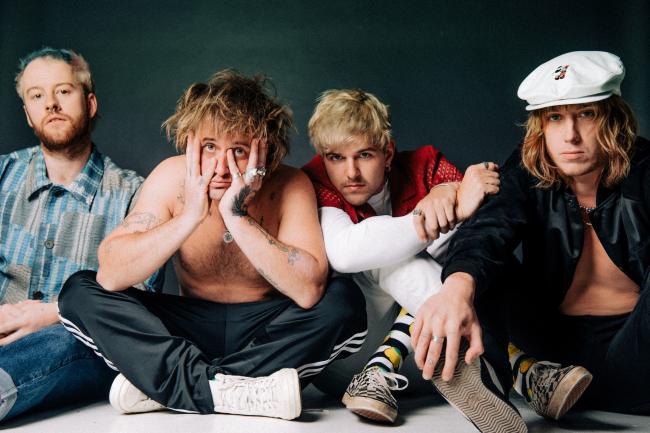
Brian Destiny at Dash the Henge HQ, shot by @stiff_material.

Growing up in Northern Ireland in the Noughties, Nathan’s interest in music was piqued by Top 40 giants like Michael Jackson and Dire Straits, as well as: “Motown, that stuff I fucking love…My dad was obsessed with Cat Stevens, and the Eagles, so I got into them very young. Bob Marley… I love that song, ‘Bad Boys.’ The hits, the big tunes. Eminem, Elvis Presley. I love ‘em all.” 

 “I DJ’ed. Got a pair of decks when I was 16. Just in my room. Techno. Guitar I wasn’t as enthused by, but I still liked it because I saw it as a way to get into the music world. I still love techno. I’m doing another thing called Soft Tip; I don’t know if it’s techno or house, but it’s fucking dance…” 

He pauses to take a deep draft of strawberry smoothie from a blender—pre-gig nourishment, he’s playing with Alex Sebley’s band, PREGOBLIN, later on, at a venue in east London. The idea for a solo project in the form of Brian Destiny surfaced sometime around 2019: “It came about after the third Fat Whites album. I started writing a lot at that point.” His highly anticipated EP Brian’s Got Talent was recorded before lockdown but remained unfinished until early this year.

Writing for Brian Destiny is a serene process compared to writing for the Fat Whites, where so many fertile minds clamor for track space. Nathan’s favorite method is simply wandering around London until inspiration strikes: Long, solitary, walks are how most of Brian’s Got Talent was written.

“Whenever I walk more than two hours, I always get something. If you’re walking around somewhere that’s a bit isolated, you can just start singing. Strictly reclusive places. Sometimes I pick up litter when I’m walking…there’s more purpose to it. If everybody didn’t go to the gym but just walked around ferociously hunting litter, the whole country would look tidy. And these are problems that the old boys from like hundreds of years ago, that we all romanticize about, the painters, the poets—they didn’t have to contend with litter as a fucking one of their banes, did they?” 

The album’s first single, Is it Gonna Be Love? neatly sums up the differences between the Fat Whites’ and Brian Destiny’s musical missions. “It’s my basic philosophy, isn’t it? Love. I know it’s a loaded term, but if you can’t find something to do that you love doing, then it’s kind of like…pointless, isn’t it? Whatever it is, you’ve got to be doing something with love. That’s it. That’s the solution.”

Lou Smith, (the Fat White Family’s longtime photographer, documentarian, and friend, who often visited the Fat Whites during their tenure in Sheffield where Nathan ran the studio in which the band recorded their third album, Serf’s Up) says: “There was no social life in Sheffield, it was grim, freezing, grey, rainy, horrible. So, he built up that studio there, Champzone…he’s developed a very strong sense of what he wants. He’s definitely on a mission. And he knows how to get the best out of people…”

Running Champzone was good practice for Dash the Henge, which Nathan started because, “I’ve always wanted to have a little label. He drops the astounding comment that music wasn’t his first plan in life, but, as he says: “I wanted to have a laugh. And it’s good for community, isn’t it?” 

In an era defined by increasing feelings of isolation due in part to social media, close communities are at last being recognized for the precious commodities they are. Starting his own record label seems to be a continuation of Nathan’s desire to meld a tight creative community. Since establishing himself in the new headquarters of Dash the Henge above Earl Ferrers, he’s initiated open-invitation jam sessions, an everyone-gets-a-seat-at-the-table affair called Avant Practiced. There’s free curry afterward, and an inevitable slew of photos of some of south London’s best musicians gathered into a tiny room, riding the sonic waves wherever the music takes them, on Instagram the next morning. 

Nathan wants the two-headed beast of Avant Practiced and Dash the Henge to function as a think tank for local musicians: “You’ve got to make it plausible to do research, otherwise it’s just all this talk. Everyone has to rely on one another, but whenever you’ve just got an impulse to make something, and then you’re relying on someone who doesn’t quite understand that impulse, that’s when people start to get frustrated. You’ve got to make a little space…”

Liam May of Trashmouth Records, (the first label to sign Fat White Family, over a bottle of cheap sake, back in 2012) says of Nathan: “It’s impossible to quantify the kind of lubricating influence Nathan has on a band as dysfunctional as the Fat White Family. But the truth is, they wouldn’t have been able to move forwards, backwards, sideways, or anyways without him. Maybe it’s the casualness with which he picks his nose that has the power to disarm even the most searing animosity and crippling self-doubt? Who knows? It’s never easy to explain genius, and the beauty of magic is always in its mystery. . .”

Brian Destiny’s debut EP, Brian’s Got Talent, is out on Dash the Henge records in January of 2022. You can follow him on Instagram @briandestiny and @dashthehenge. His recent single, Is it Gonna Be Love?, is available to stream on all platforms.

Categories
Pop/Indie Pop Reviews Videos

Prioritise Pleasure: Self Esteem’s Story of a New Girl Power

“Girl Power”: The immortal slogan of the Spice Girls and title of the 1996 album by Shampoo. However, its origin supposedly comes from a zine published by the US punk chicks of Bikini Kill in 1991. In The Rolling Stone Encyclopedia of Rock & Roll, it is written that ‘they articulated an agenda for young women in and outside of music.’ 30 years later, and we are presented with Prioritise Pleasure, the highly-anticipated new album from Self Esteem. 

It is a manifesto for the modern girl, a cornucopia of style punctuated by battle cries, all while celebrating strength and vulnerability. Throughout 2021 there has been a steady release of singles and videos, as well as a slam-dunk on this year’s festival scene, all creating anticipation for the album itself. The reviews are in, and they are stratospheric, stars upon stars upon stars as far as the eye can see. 

Self Esteem is the creation of Rebecca Lucy Taylor, formerly of Sheffield duo Slow Club. In interviews, she has described wanting the experience of Self Esteem to be without boundaries. You are one; you are included as you listen to her or watch her perform. This is made easy by the raw authenticity she represents. 

Sometimes a song can strike you like lightning, paralysing you in some half-forgotten moment while the world around you melts into a soft-focused slow motion. Although it’s often that a song can be like a horoscope and pull you in with the generalised feelings about living that we all feel, you are rarely presented with words and emotions that tug at such specific pieces of you; it’s as though someone has ripped pages from your diary and put them to music, or plucked the memories straight out of your skull. 

With Self Esteem, I was presented with that standstill moment as I flicked through my Spotify Discover Weekly on a hot overground train in June. “I Do This All The Time” burst through my headphones, “Look up. Lean back. Be strong. You didn’t think you’d live this long.” The chorus is disjointed, a broken-voiced howl with soft harmonies spread beneath like butter, before you are met with a slow, steady sermon: “Old habits die for a couple of weeks, and then I start doing them again.” 

I was transfixed by her honesty and drawn in by the intentional and rhythmic way she spoke. There’s been a resurgence in the musical spoken word, with artists such as Kae Tempest and Sinead O’Brien heading the charge. With “I Do This All The Time,” Self Esteem capitalises on this fresh yearning for the overlap of poetry and production, the desire for recitation and a narrative, and the narrative she gives to us throughout is a compelling reflection of our own. 

We are launched into the story by “I’m Fine,” an accusatory statement with the fire of female rage – it is the outburst that comes as the product of silencing yourself for someone else. The following album is peppered with recurring motifs; you catch lines that repeat from one song to the next. 

The lyric, “My hunger times my impatience,” appears firstly in “Fucking Wizardry” in an expression of how the feeling opens you up to others taking advantage of your vulnerabilities and being impulsive and reckless in their treatment of you. The lyric then appears again further down the line in “I Do This All The Time”: “Now and again you make complete sense,

but most of the time I’m sat here feeling stupid for trying, my hunger times my impatience equals the problem.” This time the hunger and impatience put us at fault, for allowing our expectation of someone else’s behaviour to exhaust us and get in the way of our happiness. 

The whole album explores mutual accountability and how much we can blame ourselves or others for negative cycles of behaviour. It touches on forgiving, or not forgiving, self-love, and balancing that with the utterly human need for love from others. 

“Hobbies 2” is fuelled by the apathy of hook-up culture and how women train themselves to match the energy of what they are presented with; for many of us, the modern sex-positivity movement didn’t come with the warning label to teach us about demanding and expecting aftercare till it was far too late. 

This is followed by the album’s namesake Prioritise Pleasure, a heavy and pulsating celebration of letting go of the behaviours that are for the sake of those around us and not ourselves. The backing vocals are pure gospel; you can imagine them filling the high and cavernous ceilings of churches. The effect feels like a shared spiritual epiphany. 

Recovery and rehabilitation aren’t linear, and this doesn’t just apply to substances. It applies to behaviours, experiences, trauma, and relationships. Despite the power and conviction of Prioritise Pleasure, the songs that follow subvert the expectation of where you would want a Hollywood version of the story to take you. 

The mood drops as “I Do This All The Time” explores the grief of the self and the parts of ourselves that we willingly sacrifice; it climbs through your mourning till it reaches that optimistic climax where we promise ourselves that we will be okay again. “Moody” then pushes us back down again; we’re sexting our exes “during the mental health talk,” we’re drinking too much, we’re struggling to accept the reality of a foregone conclusion. 

This bargaining stage of sorts continues through “Still Reigning,” where we are once again falling back into the pattern of placing the needs of others (“The love you need is gentle, the love you need is kind”) over ourselves (“I feel everything, and nothing at all”). We relapse into our bad habits, we’re not taking care of ourselves, which brings us to the brilliant anger of “How Can I Help You.” 

With a Yeezus drumbeat loud enough for the gods to hear, the lyrics are spat into the face of those who have wronged us in a sing-song-shout of a chant that mimics schoolyard bullying. Female rage is vilified, sexualised, and used against us – it is refreshing to hear it so rawly expressed, especially at a time when so many women feel unsafe at the hands of men. 

“It’s Been A While” takes us back to mutual accountability, but this time focuses on how it feels to try to heal when you don’t feel like the other side is letting go of you either. Once more, we are secondary, we are an afterthought, but for as long as we know we still linger there, it will be all the more difficult to move on. 

So we need “The 345,” a soft and slow expression of trying once again to rebuild self-love.

It’s a monologue spoken to yourself in the mirror, encouraging the creation of new promoting purpose and motivation in the wake of previous plans falling apart; it’s a gentler spin on Prioritise Pleasure, still encouraging living for the self but whilst trying to figure out how to treat yourself with tenderness. 

Following in its wake is “John Elton,” where we truly start to feel the loss and try to figure out what to do with it: “So, this all that’s left of it, a dull ache in my stomach pit, as I try to make the memories fit a less rejecting narrative for me.” Our longing is still present in “You Forever,” and we have come to accept that it may never leave but acknowledge how well we’re doing on our own. The tune is bright and optimistic, we still hold the love, but we are capable of living. 

Finally, we reach “Just Kids.” We all remember how we met the people we fall in love with, and maybe we remember it just outside of reality. La vie en rose kicks in, the heady drug of romance clouds over any mishaps or words are spoken out of turn, but that doesn’t matter. The human memory is a subjective and everchanging thing, and we were fortunate to once 

be in a place where love could bloom and grow, despite whatever happened next. We’re finally forgiving, both of others and ourselves: “Maybe you didn’t really mean to make me doubt my life, and it really wasn’t okay, but I never did say, and I feel so sorry for you and me.” 

Self Esteem’s girl power isn’t only about anger or what defines femininity. It’s about making space for yourself, as a woman, first. It’s about understanding your emotions, knowing where your relationships, your family, and the patriarchy may have adapted and changed who you are and whether you wish to accept those changes or fight against them. It’s about analysing yourself and your relationships, not accepting things as black or white, and about taking responsibility for yourself where you can. 

It’s self-care, it’s grief, it’s healing, and the best part is that we can all share these experiences together. We can empathise and understand where our experiences aren’t the same as others; we can support one another through our highs and lows and guide one another when we falter. We can know when to step back, when to allow our emotions to run their course, and when we can forgive. 

Prioritise Pleasure is Self Esteem’s moving tapestry about finding your power through the pain, and I hope it inspires us all to accept and love ourselves in a new and exciting way. Changing for the better and learning how to live with yourself is a scary thing, I know. But isn’t it so very exciting?

Categories
Creators Monthly Punk/Rock Reviews

Don’t Die in the Waiting Room of the Future

Tim Mohr’s Burning Down the Haus: Punk Rock, Revolution and the Fall of the Berlin Wall is an essential history that reveals punk’s wrath and how it contributed to the downfall of the East German dictatorship.

Throughout history, reigns of terror crushed hopes, ideas, behaviours; we’ve seen it all – intimidation and manipulation, violence. We’ve seen walls. Tall, made of concrete and strengthened with steel, with a strip of land guarded by merciless apostles of havoc by whose hands hundreds died. You would think nothing can break through it, but soundwaves don’t stop at borders. Soundwaves travel.

Mohr’s book is a compelling account of untold stories that starts with a handful of Berlin youths who heard the Sex Pistols on a military radio broadcast. Unlike British punks, who were living in a society that couldn’t guarantee them a bright economic future, East Berlin punks fought the battle of Too much future – the dictatorship had everything planned for them. Punk was a cathartic discovery, where chopped-up hair and clothes, loud singing and buzz saw guitars turned into a revolutionary philosophy of resistance.

Tim Mohr was able to closely observe this uniquely Eastern phenomenon when he moved to Berlin in the early 90s. Oblivious to the reality of the post-Wall city, he started exploring the nightlife scene, the clubs, the squats. He worked as a DJ for 6 years, a time during which he befriended many of the East German punks who were interrogated by the Stasi and imprisoned by the GDR – and ultimately helped build a fascinating, progressive DIY world.

East Berlin punks on Lenin Platz, Friedrichshain, ca. 1982

Mohr spent ten years researching Stasi files, tracking down and interviewing the punks whose stories were indispensable – teenagers who were spied on by families and friends, fired from jobs, beaten up and imprisoned, but not just because of their clothes or the lyrics they sang. It was more than that. Punk rock was a weapon against the tyranny that smashed protestors and militarized the police. It was a tough fight that had its manifesto disseminated in churches, safe havens offered to the teens by compassionate deacons. Not even jail could stop these kids. They got out, put their leather jackets back on and boy, did that hell break loose.

Burning Down the Haus is a fiery, dramatic history about the grit and spirit of a bunch of young punks who played a fundamental part in bringing down the Berlin Wall. Intensely researched, riveting and satisfying, it is a great book that passes on the legacy of grassroots oppression fighters. Maybe the lesson here is what they used to spray on walls: Don’t die in the waiting room of the future.

Burning Down the Haus: Punk Rock, Revolution, and the Fall of the Berlin Wall is available in Rough Trade physical stores and online at World of Books.

Categories
Indie/Indie Rock Pop/Indie Pop Reviews Uncategorized

Indie Idols: Will and the People

Image by Daniel Harris

Have you ever attended a concert and decided to skip the support acts? After all, they’re not who you’re there to see and one more drink in the bar is so tempting! If you have, I must say I think you missed out on some possibly brilliant music. I used to think that the support acts were just an unnecessary warm up to the main event, however, I have come to realize the error of my ways, and have since discovered some impeccable artists supporting others. This month’s Indie Idol is evidence of that. In 2019, I attended a Barns Courtney concert at the Electric Ballroom in Camden, London, and had looked up the support acts, Ulysses Wells and Will and the People, on Spotify before going in. Now I must admit, I was not entirely convinced of Will and the People’s music when I first heard it but after seeing them perform, in their underwear I might add, I was hooked. Their performance was incredibly energetic, charismatic and addictive, and I have since seen them again – most recently at Boardmasters festival just over a week ago. At which their performance was once again sublime and full of frontman Will Rendle’s usual antics – crowd surfing for example.

Hailing from Brighton, Will and the People formed in 2010 with brothers Will and Jamie Rendle (although Jamie joined later), Charlie Harman and Jim Ralphs and are considered by many as one of “the most down to earth bands, who appreciate every single one of their fans and put 110% into their live shows!”* It is with no doubt that Will and the People definitely go over and above with their gigs, the atmosphere is electric and shows tend to be a generally riotous experience, whether they’re the support or headline act, Will and the People will be a highlight of your night. The band have so far released four albums, with a new one promised for November, and it is difficult to classify Will and the People’s music into a single genre as every song is so distinct from each other that the variation is like a signature of the group. One of the band’s earliest tracks, Lion in the Morning Sun, for instance, has some very obvious pop music vibes but is full of ska and reggae fervour, with a strong but fast paced walking beat, almost reminiscent of the ska-punk or 2 tone genre that rose to popularity with bands like The Specials or The Mighty Mighty Bosstones, whereas more recent tracks like Justify, a track released in September of last year, has a more emotional rock ballad sound merged with rap elements and ethereal aspects similar to that of the band Evanescence. 

Of the band’s work, the song that stands out most to me as something special is the 2019 single Gigantic. Lyrically, the track tells the story of love, specifically familial love and how the people you choose to surround yourself with and those who love you can make the world better than anything. It discusses the sentiment that you would do anything for your family and friends, as evidenced in the first lyric, “I could be there for you, if you want me to,” as well as, the idea that even if you’re feeling down or lonely you will always have your family and friends to fall back on, just as they would have you, no matter how far away you are. The accompanying music video effortlessly depicts the warmth and sentimentality of the song, as it is presented as a sort of home video, going from door to door collecting relatives, young and old, to go to a large family get together. Hearing Will call his grandmother in the opening seconds really elevates that feeling of the music video and overall creates a human connection with the audience as you almost feel like you are part of the family.

Lucky for all who love them, Will and the People have a new single coming out on the 27th. In two days! Animal, a long awaited song that has been all over the world in its production stages, is sure to blow your mind. And! To add to the excitement, are on tour around the UK right now, and then all over Europe in the first few months of 2022.

*Quote from Tom Embling, who saw WATP on the 22nd in Bristol, where they, once again, performed in underwear. The tour wardrobe must be very compact!

Categories
Creators Monthly Indie/Indie Rock Punk/Rock Reviews Why We Love

Why We Love: Kitner

Kitner. From left: Conor, James, Will, Brianne

The local music scene is an ever changing landscape no matter where you come from. When I started making music with my band Friday Life back in 2017, there were around five bands that comprised the music scene, maybe a few more. However, four years on, Friday Life is the only band left standing, and that’s remarkable even to me. Local bands breaking up happens for a multitude of reasons: people begin going to college, members move out of state, scandals radically shift the prospects bands once had, the list goes on. It is as common as it is unfortunate.

For awhile, Boston based band Kitner seemed to be another local band come and gone. Forming in 2015, the band started as a five piece featuring Conor Maier (guitar, vocals), Brianne Costa (keys, vocals), James Christopher (guitar), Christine Atturio (bass), and Will Buiel (drums). They quickly recorded an EP of home demos, followed shortly by the release of a self-titled EP in September of that year. 

The EP gained momentum, with many people downloading it on bandcamp. The band played a few shows in Massachusetts over the next year as well. They even teased a return to the studio. However, due to their commitments to other bands as well as some member changes, the band vanished. For over four years, Kitner seemed to be just a memory, with the self titled EP being all that remained.

However, in 2019, Kitner quietly returned to the studio. Now a four piece consisting of Conor, Brianne, James, and Will, the band recorded their debut album, titled Shake The Spins. Announcing their return in April of 2021, Kitner set to work promoting their new album, set to be released in October through Relief Map Records. The hype was immediate, not just because the long absence had allowed their previous EP to garner a larger following, but because the music involved sounded incredible.

The first single from the album, Beth Israel, was premiered on July 29th by The Alternative. Starting with some mellow but present acoustic guitar, the muted vocals soon enter, giving the song a primitive feel, like a bedroom demo recorded on tape. It is warm, and it builds anticipation for when the wave comes crashing down. 

Sure enough, the wave hits a little over a minute in. Roaring, anthemic guitars meet steady, powerful drums that hit you like a train. The hushed vocals are replaced by rough, raw shouting from Conor that brings to mind an alternate universe where Jim James of My Morning Jacket fronted an emo band. Brianne’s light voice perfectly compliments Conor’s vocals, adding a dimension to the music that fits in your ears just right.

The wall of sound soon breaks in the final act of the song, with the acoustic guitar and softer vocals returning, accompanied by the solemn wail of a feedbacking guitar. The interplay of Conor and Brianne’s voices is clearer here as the two sing different lines, creating a tapestry of words and sounds. The drums begin building up again before sending the song off with bluster accompanied by some retro sounding keyboards.

Kitner’s return can only be described as triumphant, and that’s after just one single. If the rest of the album sounds like this, then Shake The Spins might easily be the album of the year. 

Kitner. From left: Brianne, Will, James, Conor. Photo by Brittany Rose Queen

Bandcamp: https://kitner.bandcamp.com/album/shake-the-spins

Spotify:

Instagram: https://www.instagram.com/kitner.ma/

Categories
Reviews

Woo! Strange Happenings at the Windmill and Other Tangential Rants-A Review

Madonnatron, Shame, Warmduscher, Fat White Family, Meatraffle, the Moonlandingz, Goat Girl, Sorry, Pregoblin, Insecure Men and, yes, Secure Men—they’re all there. Large as life and almost as loud. It’s a testament to his storytelling ability that Dave Thomson, author of Woo! Strange Happenings at the Windmill and Other Tangential Rants, a free-wheeling gonzo history of the last ten-plus years of south London’s fertile music scene, can conjure up such a diverse cast of characters. While the rest of the so-called civilized world suffers through a banal, auto-tuned repetition of vanilla pop, south London has been blessed with artists unafraid of criticism or cancellation and therefore transcendent. 

Thomson, who has been an initiate of London’s diverse music scenes since his twenties, hadn’t thought of writing a history of the south London scene in particular, until, as he says: “… after a drunken conversation with Alex Sebley of Pregoblin, during Madonnatron’s debut album launch party (held at the Windmill Brixton in 2017), in which he practically challenged me to write it down, to document it all in some way and capture some of the magic brewing. So, I had a go, the result of which is this book.”

Saul Adamczewski ( Fat White Family, Insecure Men) and Alex Sebley (Pregoblin.) Photograph by Lou Smith.

Written with a cutting perceptiveness akin to Hunter S. Thompson, and with Anthony Bourdain’s ability to nose out juicy metaphors and similes, Woo! is a satisfying read. Like that venerable punk bible, Please Kill Me, or Henry Rollins’ hallowed tome, Get in the Van, Woo! is equal parts how-to DIY guide and spiritual helpmeet for the souls of the moshers, the music-addled and the amp-deafened. It’s a balm of Gilead for feedback-starved formerly (ie, pre-Covid) avid gig-goers, interspersed with canny socio-political commentaries and run through with threads of events from the author’s personal life, including an all-too-familiar tale of friendship on the rocks.

Madonnatron and La Staunton. Photograph by Lou Smith.

Thomson, who owned and operated an alternative record store in northern Lincolnshire before moving to London aged 20, became a confirmed devotee of south London’s musical progeny upon seeing the Fat White Family play at the Electric Ballroom in 2014. As he describes, he was, “…instantly smitten and before long found myself drawn into the heart of this peculiar musical community. I soon realised something uniquely special was happening, but moreover, why it was happening – because unlike the Thatcher years, this time London was suffering too. People felt battered by austerity, exasperated by corruption and angered by gentrification – all of which gave everyone involved a sense of purpose and solidarity, the like of which I had not seen since moving to London all those years ago.”

From attending Madonnatron’s first album launch party (“like a witches’ choir in a Tim Burton movie,”) to Zsa Zsa Sapien’s of Meatraffle’s gold front teeth (“like he’s been punched in the mouth by Midas,”) to the origins of Fat White Family (“Barely noticed at first, like bacteria left to fester within a neglected Petri dish, something alien, unwholesome and seriously strange took form… Something very fucking special,”) Woo! is a series of candid snapshots of a unique place in time. To preserve a history is to perpetuate it; Woo! helps to cast the scene in amber.

Ben Romans-Hopcraft (Warmduscher.) Photograph by Anna Yorke.

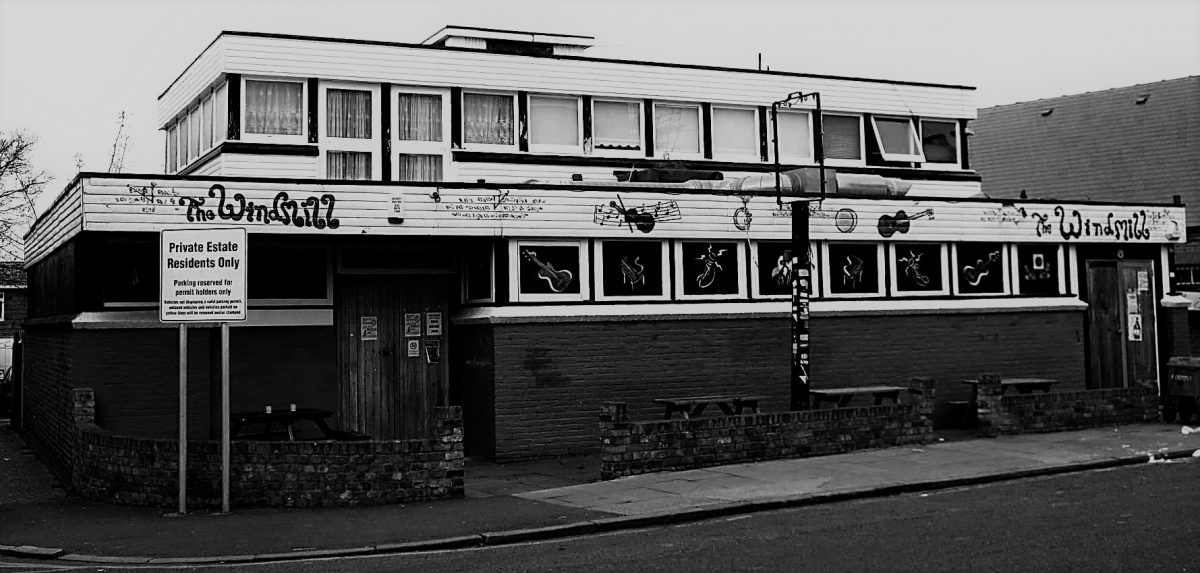
At the heart of the book, is, of course, the legendary musicians’ haven known as the Windmill Brixton, described by Thomson as: “… a veritable microculture, a disparate melting pot of musicians, artists, poets, chancers, DJs, bloggers, blaggers, filmmakers, producers, youtubers, self-abusers, ‘oholics of all colours, all persuasions, it takes in the young, the old and every imaginable slice of humankind in between. No one is judged, all and everyone’s accepted, except, perhaps, anyone who turns out to be a cunt.” 

“…The role the Windmill plays in a band’s development is significant, for they are channeling something fantastically unique, an interstellar nursery for all manner of burgeoning talent or any nutter with a mad idea.” (Of course, in world of the Windmill, “sanity is so fucking relative…”) 

Saul Adamczewski and Ben Romans-Hopcraft. Photograph by Lou Smith.

Primarily written and edited during the onset of the pandemic, Woo! delves into many of the terrifying new variables that continue to affect our lives. It may be a book about the past, but it looks to the future, and what we’ll have to do to get there: “We are living through strange, febrile times…Truth and reason so far out of reach there’s nothing left to grab hold of, just a feeling in our bones that we’re at the end of something and the beginning of something else, yet unable to envisage precisely what.” 

You can order your very own copy of Woo! on Warmduscher’s Peasant Vitality website (linked here.) All UK proceeds will go directly to the Brixton Windmill. 

Categories
Indie/Indie Rock Pop/Indie Pop Punk/Rock Reviews

notes from the trenches

After a month of an environmental microbiology summer course at uni, and two months of unloading produce trucks at farmer’s markets, I return to you a changed girl. This means I’m absolutely exhausted, so tanned my dermatologist is frightened, and I’ve cut my own bangs again. The good thing is I’m still 20 and according to everyone I know who’s over 40, completely exhausted, broke, and sporting a questionable hairstyle is just how I’m supposed to be at this particular age, so at least I’m living up to someone’s expectations. 

Speaking of expectations, the Berlin-based chanteuse Anika’s sophomore album Change recently appeared on Billboard’s Emerging Artists chart, an exciting development in the trajectory of a very worthy artist’s career. Limited edition, cherry-red vinyls of the album are available on Bandcamp, and tickets for her upcoming fall tour are available via a link in the recent interview Totally Wired conducted with her.

2021 is the 10th anniversary of Trashmouth Records, and as Charlie Steen of Shame says: “Trashmouth fear no fever, no nausea or fatigue, no symptom can scare them; they are the antidote.” In light of that statement, I think we should place all our trust and possibly also all of our money into Trashmouth, as an antidote is exactly what we need right now, in so many ways.

Before I was exposed to the sonic wonderland created by the Trashmouth tribe, I foolishly thought all modern music could either shuffled into the category of Taylor Swift or Avenged Sevenfold, and therefore I didn’t listen to much, as when given the choice between songs about sad cheerleaders or necrophilia, I’d rather hear the sound of silence. And then along came Madonnatron and Warmduscher on Iggy Pop’s BBC 6 radio show, and I was hooked, enchanted, a devoted convert.

Trashmouth’s latest release is a single that will feature on their anniversary compilation album, a remix of Weston Decker’s “Lazy.” Weston Decker is an American artist based in Boulder, Colorado; in his Spotify bio, he purports to have been conceived in the Dallas-Fort Worth Airport. I consider DFW to be the first circle of hell in my own private model of the inferno, so I tip my hat to anyone who has been summoned into being somewhere in its chaotic grey arteries, and managed not be plagued by demons, etc. “Lazy,” is a tasty little indie pop number with an infectious rhythm, and the Trashmouth remix of the song has sharpened it–brought out its cheekbones, as it were—the driving electronic beats making a good thing even better.

Also on the Trashmouth release radar is a remix of Madonnatron’s “Venus and Rahu,” out today on all platforms. According to their Spotify bio, Madonnatron formed by “arising unabashed from the mists of the Thames.” In 2019 the band released Musica Alla Puttanesca, a much-lauded musical experience (the album cover of which depicts the laser-eyed gaze of the Madonna setting the world aflame, a theme which falls perfectly in step with Madonnatron’s usual agenda of the more darkly delicious art forms) on the Trashmouth label.

The Spanish rock supergroup Hinds recently collaborated with the German musician Kid Simius on a driving, upbeat, club track entitled “We Like to Party,” out now on Jirafa records. It’s the ideal track to make summer last a little longer, to stretch out those last lingering days of warmth and relative freedom. Hinds like to party; I remember watching them give a full-throttle rock n’ roll performance in an abandoned church at 2 a.m. one hot summer night a few years ago, and being duly impressed with their IPA consumption, as well as their musical prowess. 

This, then, is my final “notes from the trenches,” as I think everyone has swallowed quite enough of my opinions over this long, hot, pandemic summer. In the words of Groucho Marx, “Art is art, isn’t it? Still, on the other hand, water is water! And east is east and west is west and if you take cranberries and stew ‘em they taste much more like prunes than rhubarb does. Now… you tell me what you know.” It’s someone else’s turn to give you their opinions on life, music, the universe, and everything. If you need me, I’ll be in the bar. All you have to do is whistle. 

Categories
Indie/Indie Rock Pop/Indie Pop Reviews

notes from the trenches

I don’t like festivals all that much (mud, granola and hallucinogens are a very bad combination in my opinion, especially when you could be going swimming), but I missed them like hell last summer when they were a total impossibility. It’s cheering to have them coming back, albeit in a small capacity. Instead of having a quiet cry whilst reading Glastonbury According to AA Gill, we can experience festivals in person again—at least to a certain extent. 

Anyone who thinks they can socially distance a mosh pit has another thing coming, however, as a socially distanced mosh pit would basically be paying to go for a three-mile run. Imagine what the aliens would think. Humanity must be a sort of never-ending Marx Brothers film to extraterrestrial lifeforms…

But never mind that, onwards to Very Important Music News. The Cambridgeshire-based indie-pop duo Collars debut EP Everything Present 1 dropped on July 16th, and it’s prime summer listening. You can catch the duo live at any number of venues across the country this summer and fall.

Lil Simz’ recent collaboration with SAULT, Nine, is absolutely unmissable. It’s the only album I’ve had on repeat all month. Come for SAULT’S signature smooth melodies and addictive beats, stay for Lil Simz’ witty, introspective raps.

Nathan Saoudi’s band Brian Destiny debuted loads of exciting new material at a socially distanced show last month. Totally Wired’s very own James George Potter went to investigate and was instantly hooked by the Brian Destiny sound, “I Wanna Be Gay,” being the stand-out tune of the evening. 

Trashmouth Records have released a remix of Meatraffle’s The Horseshoe. I could write a lot about it but there’s already an article up on it, so I’ll just say it’s an absolute bop, because it is.

It’s a short column this month, as the heat is affecting my cognitive abilities. Signing off now to submerge my head in ice or to listen to Everything Present 1 again–both are equally effective ways to calm down and cool off. It’s either that or move north, and I just don’t have the patience to deal with snowshoes and the possibility of getting involved in rumbles with polar bears over fish finger sandwiches. It’s just not worth it, and I’m not going vegan again. Much like this column, life is far too short.

Yours in solidarity and Bandcamp Fridays,

Annie x

Header Photo Credit: Brian Destiny live at Oslo Hackney by James George Potter

Categories
Creators Monthly Indie/Indie Rock Punk/Rock Reviews Why We Love

Why We Love: Cabin Boy

I remember my friend John “Guppy” Guptill first mentioning the idea of Cabin Boy to me last July. What immediately stood out to me about the band was that each member was from a different area of the world. He then played me a demo they were working on, and I was even more intrigued.

In recent years, I personally feel that the emo/math rock genre has become somewhat tired. While there are many bands who pull off the style well, there are several more that don’t do anything new with the sound, leading to some aspects of the genre becoming tired tropes. That’s why when there is a band that not only improves upon the sound, but also makes it their own, it immediately stands out. 

A few months after this initial reveal of the band, Cabin Boy began building up hype incredibly quickly, and they hadn’t even released music yet. The buzz was largely due to the kinetic chemistry displayed by the band’s members: the aforementioned Guppy, a bass player from Cape Cod, Massachusetts; Josh Cartwright, the vocalist and guitarist of the band who hails from Liverpool, England; and Dan Goellner, drummer extraordinaire from Berkeley, California. Meeting through an online music community, the three bonded over shared musical tastes and began sending music to one another to build songs individually—a perfect setup during the pandemic.

Recruiting producer Max Mayman, who Guppy has described as “the secret fourth member of the band” and who Dan met at a concert in California, the band debuted their highly anticipated first single, “Falcon Brunch.” Released on February 14th, 2021, the song was a smash hit and received raving reviews from fans; it is truly a gem. Featuring bright, jangly guitars reminiscent of 90’s power pop, the song kicks into gear once Dan’s confident, upbeat drumming and Guppy’s melodic bass lines come into play. Josh’s voice is interesting as well; it sounds effortless and carefree, while also carrying an emotional weight that feels natural. The song bounces along, and even during the instrumental break in the middle, which features some gnarly finger-tapping, it remains unpretentious and fun.

The single proved that Cabin Boy could take their lively personalities and instrumental talents and turn them into something great, despite thousands of miles being between them. They did this so well that a few months later, they signed to notable emo label Flea Collar Tapes on May 16th. Shortly after this big news, they also released a music video for Falcon Brunch. A visually stunning affair, the video utilizes green screens in an incredible way, courtesy of Dan. Each member’s charm and charisma are on full display throughout the video, and it is a joy to watch.

The wave that Cabin Boy were riding grew in June when they released their follow-up single, “Tokin’ Tree,” on the 19th of that month. The song starts with jagged acoustic guitar chords and passionate vocals from Josh. After a little under a minute of this, the electric guitar, bass, and drums burst onto the scene ferociously. The song features a far more distorted, darker sound, but the punk ethos of Falcon Brunch is still there in the undertow. Dan’s drumming is crazy on this track, highlighting how great of a drummer he really is. Overall, the song shows a remarkable maturity in the band’s sound, and it’s only their second song. 

Cabin Boy hit a new high when renowned music critic Anthony Fantano reviewed the song and praised it. This, combined with their record deal, indicates a remarkably bright future for Josh, Guppy, and Dan. Despite the distance between them, they have proven that great bands can conquer all odds to make amazing music. Their unique energy and uplifting personas are sure to continue to win over music fans far and wide, and hopefully someday, we will get to see them come together and perform.

From left: Guppy, Dan, and Josh

Support Cabin Boy on Bandcamp!

Categories
Indie/Indie Rock Reviews

Review: Billie Marten – Flora Fauna

Billie Marten has returned with her third album, Flora Fauna. Back in January when its release date was announced, I immediately called dibs on writing about this record. After stumbling upon Billie’s music through the wonders of Spotify around this time last year, I have been fully captivated by her ever since. Euphoric and otherworldly, her music is the embodiment of stepping into a stray patch of light where the sun managed to peek through. 

With a two-year gap between Flora Fauna and its predecessor, Feeding Seahorses by Hand, I fully believe that it was well worth the wait. Each song is masterfully crafted with an almost entrancing sort of magic that envelops you in a warm embrace. With a voice comparable to silk, effortlessly gliding through the soothing instrumentals of each track, a moment of bliss is promised the second you press play. 

“Garden of Eden” was the first track unveiled to the public, and it is—without a doubt—one of my favorites. Everything about it is utterly stunning, but do not even get me started on that chorus. It’s one that makes you feel truly alive and elated to be so. Evoking feelings of freedom and contentment, this track has been on repeat. I mean, can you blame me? Absolute goosebumps.

In an Instagram post, Billie writes:

“It’s about the competition to grow and constantly be better, about how we all desperately need to be fed and watered and given space to thrive, and yet we’re so subscribed to this idea of pushing and evolving that we’re not actually doing the living part.”

“Creature of Mine” and “Human Replacement” were the other two tracks revealed prior to the release of Flora Fauna. Both of these songs are divinely rich and mellifluous, and although they bear different musical qualities and approaches, they complement one another magnificently. Out of the two, I would choose “Human Replacement” as my personal favorite; the lyrics, the band, the melodies… everything.

The meaning behind this track is significant as well. Shedding light on a devastating reality, Billie emphasizes just how unsafe every little task can be for women. Her impactful words have a thunderous music video to match, and I strongly encourage you to give it a watch.

You’re just not safe in the evening

Walking around

You could be taken

You’re just not safe in the evening

No room for doubt

Human replacement

“Ruin” is another show-stopper. I’m obsessed with how the instruments interact with each other in this song, going from somewhat of a playful riff in the verses to a brilliant explosion in the chorus. It’s an extremely clever arrangement that undoubtedly serves its purpose in telling the story lyric by lyric. On that same note, these lyrics are incredibly compelling as Billie expresses her personal struggles with self-love. 

“If I spoke about another person the way I do about myself, it would be horrific, it would be bullying,” the young singer confessed in an interview with Independent. “I was really not good on tour. I was so tired and cold all the time and couldn’t project my voice.”

The album in its entirety is mystifying. Each individual second in every song dances into one another so intricately, it’s impossible to only listen to one. With additions like “Liquid Love” and “Walnut,” why would you, anyway? This is a record you genuinely want to take the time to appreciate in full.

Like what you hear and live in the UK? You can catch Billie Marten on tour later this year, so grab tickets while you still can!